The seller's description
Reproduced as published, in the original language.
Bölkow Bo 209 Monsun
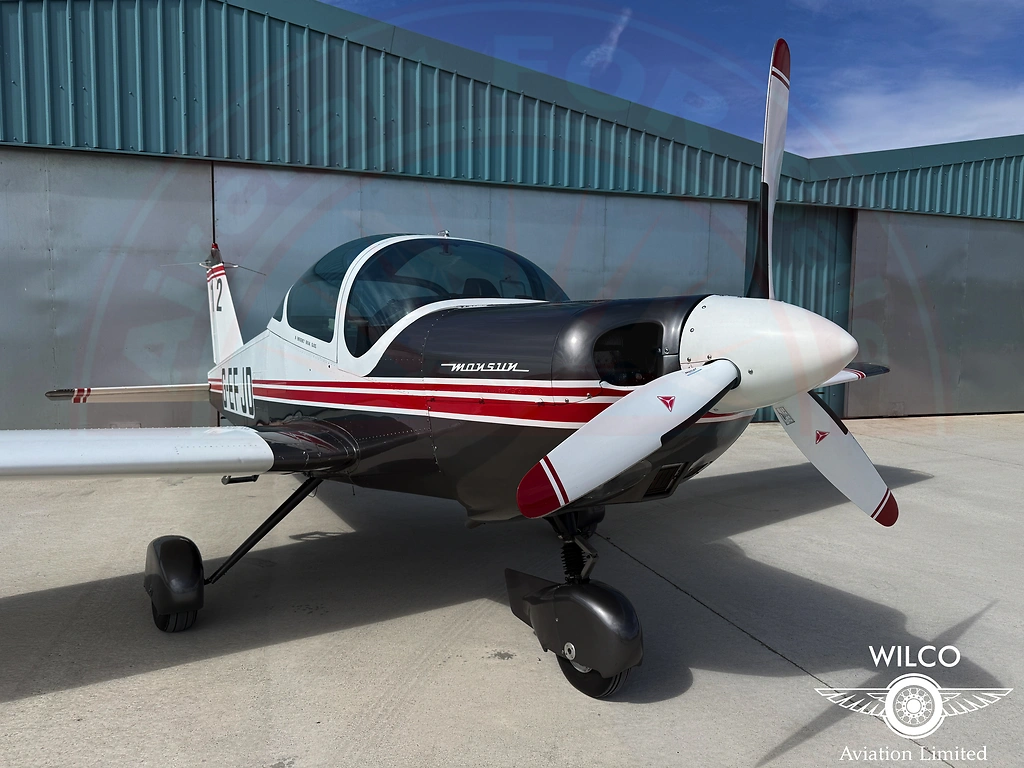
Wilco Aviation are pleased to have just exclusively listed this Messerschmitt-Bölkow-Blohm Bo 209 Monsun. The aircraft is currently hangared with us at Henstridge Airfield in the South West of England.
Having a G-meter fitted enables this aircraft to genuinely offer basic aerobatic capability of +4.4/-2.2 G. The ease of manoeuvres is complemented by the larger 160hp engine and, of course, a constant-speed propeller. Being IFR-equipped and having a relatively brisk cruise speed of 110 knots, this is truly an all-round capable aircraft.
The Monsun was designed by three Bölkow engineers, led by Bölkow's technical director Dr Hermann Mylius, in their spare time, with the intention of creating a more versatile aircraft than the Bölkow Bo 208. Design work began in 1965. The new aircraft, designated the MHK-101, was a low-wing monoplane of all-metal construction with a tricycle undercarriage, which had fixed main wheels, with the option of a fixed or retractable nosewheel. While the MHK-101 used some components of the Bo 208, it had a larger and more comfortable cockpit, and an entirely new wing, which could be folded for towing and storage (the Bo 208 was a high-wing aircraft).
The first prototype MHK-101, powered by a 125hp (93kW) Lycoming O-235 engine driving a fixed-pitch propeller and fitted with a retractable nosewheel, flew on 22 December 1967. In April 1969, Bölkow selected the MHK-101 to replace the Bo 208 in production, with the type becoming the "Bölkow Bo 209 Monsun". A second prototype flew in May 1969. That year, Bölkow merged with Messerschmitt to become Messerschmitt-Bölkow-Blohm, and the aircraft became the MBB Bo 209. Offered with a variety of engines, a choice of fixed or variable-pitch propellers, and a fixed or retractable nosewheel, the aircraft entered production at MBB's Laupheim factory early in 1970 and received its type certificate on 9 April 1970.
Juliet Delta benefits from the larger 160hp fuel-injected Lycoming engine, a fixed undercarriage on both the main and nosewheel, and a low-time MT three-blade propeller with wing fold for smaller hangars or trailer towing.
G-EFJD has a few world records to her name: two FAI World Speed Records, the Dawn to Dusk "Duke of Edinburgh's" Trophy twice, and a Guinness World Record for visiting the most airfields in 12 hours. She was displayed at the 2019 LAA Rally, where the focus was on Royal Aero Club racing.