Beschreibung des Verkäufers
Unverändert wiedergegeben, in der Originalsprache.
TST 14 M Bonus
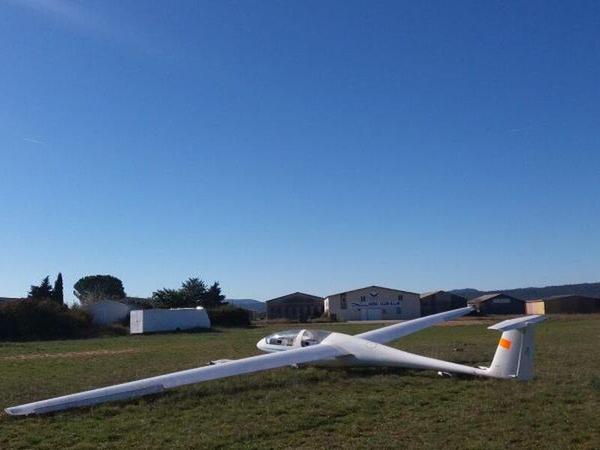
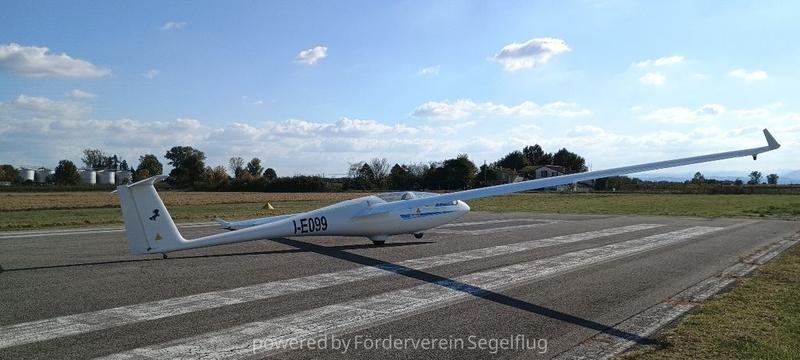
TST 14 Bonus M self-launching ultralight glider, manufactured in 2009 by "TeST", viewable in Ravenna, Italy.
Purchased in 2021 in the Czech Republic (I am the third owner).
As I purchased only the aircraft itself, I adapted a trailer to allow for convenient transport and hangarage.
The trailer is available for separate purchase ( https://www.segelflug.de/index.php/en/classifieds/detailes-search-2/ad/com-djclassifieds-planeaccessory-trailer,42/anhanger,7029 ) and is not included in the price of the glider.
There are 31 videos available (https://www.youtube.com/@ettoregrossi6257/videos) that demonstrate the assembly process and the performance of this glider in detail.
Compared to general aviation gliders, it offers average performance in terms of maximum glide ratio (40:1 at 110 km/h), while it has a VNE = 205 km/h, it has some limitations at high speeds, but it remains capable of flying at speeds up to approximately 180 km/h maintaining glide ratios identical to those of general aviation gliders.
The glider does not have flaps, and the landing gear is fixed (non-retractable).
It is well-equipped with instrumentation, facilitating effective thermal soaring (including thermal-centering aids, glide computers, variometers/glide-ratio indicators, etc.) as well as instrument flying in conditions of lack of visibility (gyroscopic artificial horizon, an Oudie IGC touchscreen , LxNav S80 flight computer, which is interfaced with the airspeed system and the LxNav FlarmMouse).
The 50 hp Rotax 503 engine enables short and rapid takeoffs and high rates of climb (3.8 m/s solo, 2.5 m/s with a passenger); it is equipped with dual ignition and CHT sensors.
Engine deployment is fully electronic and is completed by a single press of the yellow button.
Retraction is performed by a first pressure of the green button, verifying the vertical orientation of the propeller via a rearview mirror, and then pressing the green button a second time.
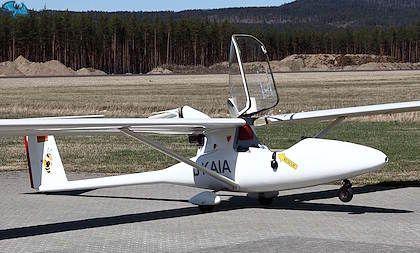
It is a tandem two-seater, and the rear seat is equipped with full controls for both soaring and powered flight, including takeoff and landing, however the "pilot in command" should occupy the front seat.
The engine can also be deployed in flight, and its 22.6 liter fuel capacity allows for approximately 2.5 hours of total powered flight, including takeoff (a typical takeoff and climb sequence generally lasts between 5 and 40 minutes).
The glider is equipped with a battery for the instruments ( 20Ah - LiFePO4 of 2024 ) capable of providing at least 8–10 hours of soaring flight, as well as a separate battery dedicated exclusively to the engine ( 18Ah - AGM of 2023 ).
A selector switch is provided, allowing the engine battery to be used for the instruments if necessary.
There are airbrakes located on the upper surface of the wings (Schempp-Hirth type), while at the wingtips (17 m wingspan) there are two 35 cm-high winglets.
Assembly can be completed by a single person in approximately 40–45 minutes, using the included motorized wing-rigging tool, which is operated via a corded remote control.
There is a wing dolly and a tail dolly, to which a tow bar can be attached, allowing the glider to be towed by a car.
The total flight time is 729 hours, 150 of which were flown under power.
The aircraft is currently undergoing an extensive overhaul (engine and ballistic parachute).
The engine is undergoing the following work:
decarbonization of the cylinder heads and pistons, replacement of spark plugs, replacement of the gearbox oil, and a general inspection.
The BRS Galaxy model 5/472 soft (96 sqm) ballistic parachute has just been sent to the manufacturer for servicing; it has a 6-year validity period, meaning the system will be certified until November 2032.
Once the overhaul is complete, the aircraft will be returned to Lugo Airport (Ravenna), where it will continue to be flown regularly until it is sold.
A test flight is possible, as a passenger in the rear seat (max weight 92 kg).
The front seat can accommodate a pilot weighing up to 102.5 kg (for higher weights, weight distribution must be taken into account).
Takeoff can be performed either with assistance at the wing or without assistance (with the wing laid out on the ground).
When operating on asphalt with two people on board, the wing lifts off without any issues within 15–20 meters.
The takeoff run on asphalt is 200 meters when flying solo and 250 meters with a passenger; on grass, these distances increase by approximately 50 meters.
An unassisted takeoff can be performed with a crosswind of no more than 15 km/h, while with proper assistance, this can be up to approximately 20 km/h.
For landing, there are no issues with a crosswind of up to 20–25 km/h, or a tailwind (wind from behind) of 20–25 km/h.
The front cockpit is equipped with a rudimentary oxygen system.
Also included are padded protective covers for the fuselage, wings, winglets and elevator,
and a dolly to keep the fuselage in an upright position when the wings are not attached